
What is Performance Marketing?
Learn what is Performance Marketing , how it works, its benefits, key metrics, and how it helps businesses increase leads, sales, ROI, and overall growth.
Introduction
In today’s digital world, businesses are constantly looking for effective ways to attract customers and increase sales. Traditional advertising methods such as television, newspapers, and billboards often require large investments without guaranteeing measurable results. This is where Performance Marketing comes into play.
Performance Marketing is one of the most powerful digital marketing strategies that allows businesses to pay only when a specific action is completed, such as a click, lead, sale, app install, or website visit. This results-driven approach helps businesses maximize their return on investment (ROI) while maintaining complete control over their marketing budget.
In this blog, we will explore what Performance Marketing is, how it works, its key channels, benefits, and how it helps businesses grow.
What is Performance Marketing?
Performance Marketing is a digital marketing strategy where advertisers pay marketing platforms or agencies only when a predefined action is achieved.
These actions may include:
- Website Clicks
- Lead Generation
- Product Purchases
- App Downloads
- Form Submissions
- Phone Calls
- Newsletter Sign-ups
Unlike traditional marketing, where businesses pay upfront regardless of results, performance marketing focuses on measurable outcomes.
Simple Definition
Performance Marketing is a results-oriented marketing approach where businesses pay only for actual performance, such as clicks, leads, or sales.
How Does Performance Marketing Work?
Performance Marketing follows a straightforward process:
Step 1: Define Goals
Businesses identify their objectives such as:
- Increase sales
- Generate leads
- Drive website traffic
- Boost app downloads
- Increase brand awareness
Step 2: Create Campaigns
Ads are created and launched on various digital platforms.
Step 3: Target the Right Audience
Businesses can target users based on:
- Age
- Gender
- Location
- Interests
- Online behavior
- Purchase history
Step 4: Track Performance
Marketing tools track every action taken by users.
Step 5: Optimize Campaigns
Campaigns are continuously improved to maximize results and reduce costs.
Popular Performance Marketing Channels
1. Google Ads
Google Ads allows businesses to display advertisements on Google Search, YouTube, and partner websites.
Benefits:
- High-intent audience
- Instant visibility
- Pay-per-click model
- Measurable results
2. Meta Ads
Meta Platforms ads help businesses target specific audiences based on demographics and interests.
Benefits:
- Advanced audience targeting
- Visual advertising formats
- Lead generation campaigns
- Remarketing opportunities
3. Affiliate Marketing
Affiliate marketing involves partnering with publishers or influencers who promote products and earn commissions on sales.
Benefits:
- Low risk
- Pay only for results
- Wider reach
4. Influencer Marketing
Businesses collaborate with influencers who promote products to their followers.
Benefits:
- Trust and credibility
- Better engagement
- Increased conversions
5. Email Marketing
Email campaigns help nurture leads and drive sales through personalized communication.
Benefits:
- Cost-effective
- High ROI
- Customer retention
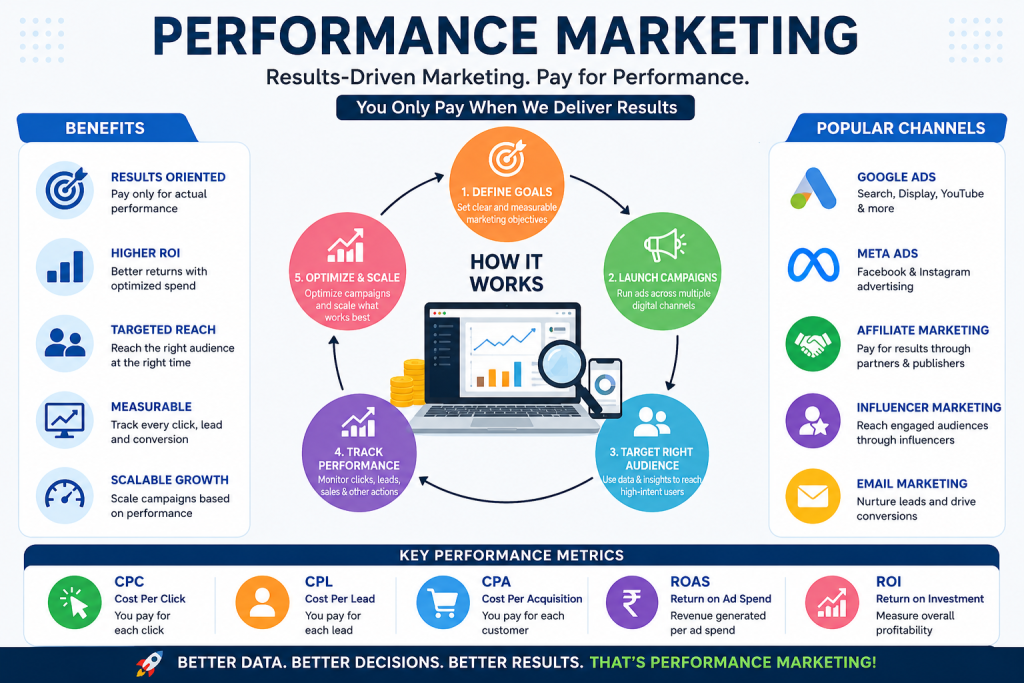
Key Performance Marketing Metrics
Businesses measure campaign success using various KPIs.
CPC (Cost Per Click)
Amount paid for each click on an advertisement.
Formula:
CPC = Total Ad Spend ÷ Total Clicks
CTR (Click-Through Rate)
Percentage of people who clicked the ad after seeing it.
Formula:
CTR = (Clicks ÷ Impressions) × 100
CPL (Cost Per Lead)
Amount spent to generate one lead.
Formula:
CPL = Total Spend ÷ Total Leads
CPA (Cost Per Acquisition)
Cost incurred to acquire one customer.
Formula:
CPA = Total Spend ÷ Total Conversions
ROAS (Return on Ad Spend)
Measures revenue generated from advertising spend.
Formula:
ROAS = Revenue Generated ÷ Ad Spend
ROI (Return on Investment)
Measures overall profitability.
Formula:
ROI = [(Revenue – Cost) ÷ Cost] × 100
How Performance Marketing Helps Businesses
1. Delivers Measurable Results
One of the biggest advantages of performance marketing is transparency.
Businesses can track:
- Clicks
- Leads
- Sales
- Revenue
- Conversion rates
This helps make data-driven decisions.
2. Higher Return on Investment (ROI)
Since businesses only pay for successful actions, marketing budgets are used more efficiently.
Benefits:
- Reduced wastage
- Better budget allocation
- Increased profitability
3. Reaches the Right Audience
Performance marketing platforms offer advanced targeting options.
Businesses can target users based on:
- Demographics
- Interests
- Online behavior
- Shopping habits
This improves conversion rates significantly.
4. Faster Business Growth
Performance marketing helps businesses scale quickly.
Whether you are:
- A startup
- Small business
- E-commerce store
- Service provider
You can rapidly increase leads and sales.
5. Real-Time Campaign Optimization
Unlike traditional advertising, digital campaigns can be adjusted instantly.
Businesses can:
- Change budgets
- Pause ads
- Test creatives
- Improve targeting
This leads to better campaign performance.
6. Improved Brand Awareness
Even when users don’t purchase immediately, they become familiar with the brand.
Benefits:
- Increased visibility
- Better brand recall
- Future conversions
7. Supports Remarketing
Most customers do not purchase during their first visit.
Performance marketing allows businesses to retarget visitors who:
- Visited the website
- Added products to the cart
- Viewed specific pages
- Engaged with social media content
Remarketing significantly increases conversion rates.
8. Data-Driven Decision Making
Performance marketing provides valuable insights such as:
- Best-performing ads
- Audience behavior
- Device performance
- Customer journey
This information helps businesses improve future campaigns.
Which Businesses Should Use Performance Marketing?
Performance marketing works for almost every industry:
E-commerce Stores
- Product sales
- Cart recovery
- Customer acquisition
Educational Institutes
- Student admissions
- Course enrollments
Real Estate Companies
- Property inquiries
- Site visit bookings
Healthcare Services
- Appointment bookings
- Patient acquisition
Travel & Hospitality
- Hotel bookings
- Tour package sales
Local Businesses
- Lead generation
- Store visits
Challenges in Performance Marketing
Although highly effective, performance marketing also comes with challenges:
- Increasing competition
- Rising ad costs
- Ad fatigue
- Privacy restrictions
- Tracking issues
However, proper optimization and strategic planning can overcome these challenges.
Best Practices for Successful Performance Marketing
Set Clear Goals
Define measurable objectives before launching campaigns.
Know Your Audience
Understand customer needs and behavior.
Create Compelling Ad Creatives
Use attractive visuals and persuasive copy.
Optimize Landing Pages
Ensure fast loading speed and mobile responsiveness.
Use A/B Testing
Test different headlines, creatives, and CTAs.
Monitor KPIs Regularly
Track CPC, CTR, CPL, CPA, and ROAS.
Implement Remarketing
Re-engage users who have already shown interest.